
Blooming
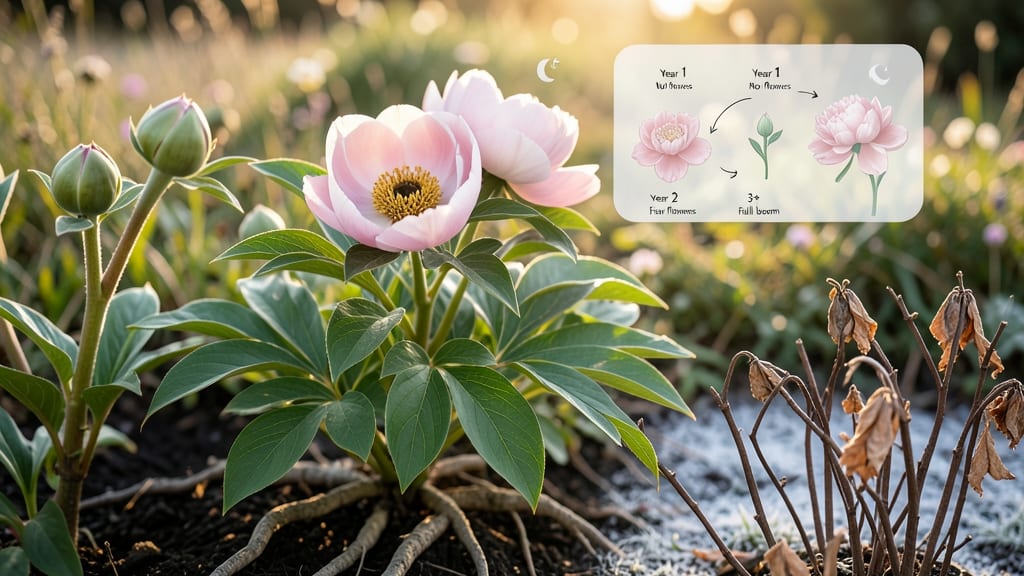
Peonies bloom every year once fully established, though newly planted or stressed plants may skip blooms for 1-3 years. Their flowering depends on proper sunlight, soil quality, and careful pruning—over-fertilizing or aggressive trimming can delay blooms.
Peonies are famously reliable bloomers, but their first few years can be unpredictable. 🌸 This happens because young plants focus energy on root growth rather than flowers—a survival strategy until they're strong enough. Even mature peonies may skip blooms if they experience drought, extreme heat, or poor soil drainage.
The good news? With the right care—like planting at the correct depth and avoiding heavy nitrogen fertilizer—you can encourage consistent annual blooms.
Herbaceous peonies (the most common type) typically bloom in late spring, while tree peonies bloom slightly later. Both types reward patience: once established, they can live—and bloom—for decades with minimal effort.
The key is balancing their needs: too much shade or overcrowded roots will make them skip flowers, but the right conditions turn them into garden showstops.
💡 In This Article
- Why Peonies Skip Blooms: Science Behind Dormancy and Stress
- Peony Care Tips to Ensure Annual Blooms
Why peonies skip blooms: science behind dormancy and stress
Peonies prioritize root development over flowering during their first 2-3 years after planting. This isn't laziness—it's biology. The plant's energy budget allocates 80-90% of its resources to establishing a robust root system, which can extend 3-4 feet deep in ideal conditions.
Only after this foundation is secure do they begin producing flower buds. 🌱 The root system must reach sufficient depth to access water and nutrients during dry spells, which explains why shallow planting (less than 2 inches deep) often leads to skipped blooms.
The dormancy period also plays a crucial role. Peonies need a proper winter chill period of 400-600 hours below 40°F to trigger blooming hormones. Without adequate cold exposure—common in warmer climates—the plant may skip flowering entirely.
Even in cold regions, extreme temperature fluctuations (like sudden freezes followed by thaws) can stress the plant, redirecting energy toward survival rather than reproduction. Environmental stressors like drought or poor soil drainage further compound this, as the plant diverts resources to repair cellular damage rather than produce flowers.
Variety matters significantly here. Herbaceous peonies (the most common type) typically bloom reliably after 2-3 years of establishment, while tree peonies may take 4-5 years due to their larger growth habit.
Some hybrid varieties, like 'Sarah Bernhardt' or 'Bowl of Beauty', are more forgiving with bloom consistency, while others like 'Karl Rosenfield' may skip blooms more frequently if conditions aren't perfect.
The key difference lies in their genetic predisposition for energy allocation—some store more carbohydrates in their roots for future blooms, while others are more sensitive to environmental fluctuations.
Light exposure is another critical factor. Peonies require 6-8 hours of direct sunlight daily to produce flowers. Insufficient light reduces photosynthesis, limiting the plant's ability to generate the sugars needed for blooming.
This is why peonies planted under trees or in shaded garden beds often skip flowers—they're essentially starving for energy. Even partial shade (like morning sun with afternoon shade) can reduce bloom production by 30-50% compared to full-sun conditions.
The plant's leaves must receive adequate light to convert carbon dioxide into glucose through photosynthesis, which then fuels both root growth and flower development.
Soil quality and drainage also impact bloom reliability. Peonies thrive in well-draining soil with a pH between 6.5-7.0. Compacted or waterlogged soil restricts root growth, while overly sandy soil lacks the nutrients needed for robust flowering.
The ideal soil mix should contain 20-30% organic matter to provide both structure and fertility. When roots can't access oxygen or nutrients efficiently, the plant enters a stress response, prioritizing survival over reproduction.
This is why many gardeners report skipped blooms after planting peonies in heavy clay or poorly amended garden beds.
Finally, the plant's age affects bloom consistency. Young peonies (under 3 years old) may skip blooms even with perfect care, while mature specimens (over 5 years old) typically bloom annually unless stressed.
The older roots have stored more carbohydrates, creating a reserve that can sustain flowering even during challenging growing seasons. This biological strategy ensures the plant's long-term survival while maximizing reproductive success when conditions are favorable. 🌸