
Blooming
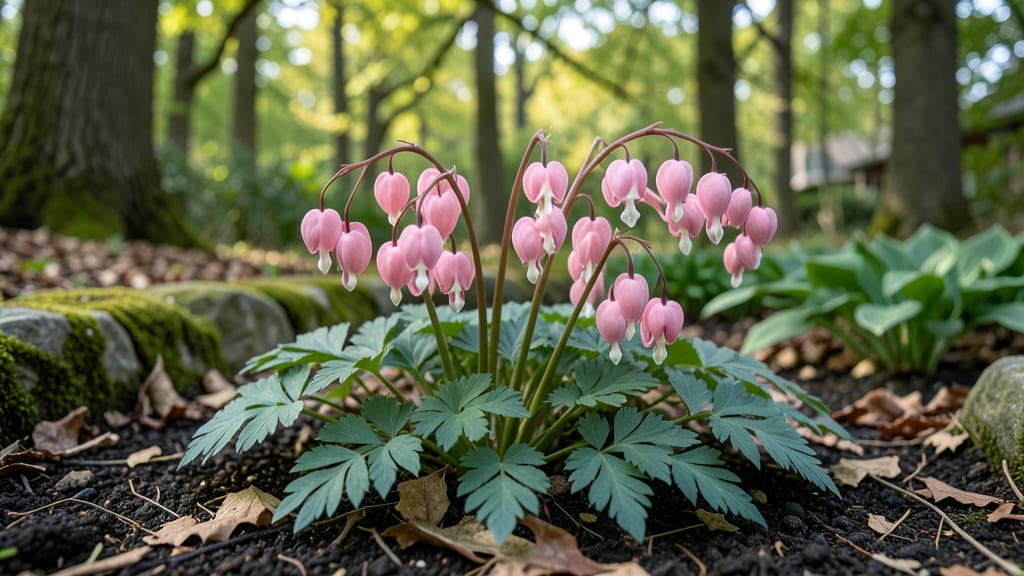
Bleeding hearts do not bloom all summer; they typically produce their signature heart-shaped flowers only in spring and early summer, with bloom cycles lasting 4-8 weeks depending on the specific variety and growing conditions. A few late-season types may continue flowering into early fall if conditions remain ideal.
Most bleeding heart plants (Dicentra spectabilis and related species) are spring ephemerals, meaning they bloom early in the season when soil temperatures are cool but days are lengthening. 🌸 The timing is hardwired into their genetics—these plants evolved to take advantage of early spring sunlight before summer heat arrives.
Some newer hybrids, like Dicentra 'Strawberry Fields', may rebloom lightly in late summer, but this is rare and requires perfect conditions. The key to longer blooms lies in proper care: consistent moisture, partial shade, and regular deadheading of spent flowers can sometimes coax a few extra weeks of color.
If you're hoping for year-round color, consider planting annual bleeding hearts like Dicentra formosa, which may produce sporadic blooms throughout summer, though they won't match the abundance of their perennial cousins.
For gardeners in warmer climates, late-summer blooms might appear if the plant receives cool evenings—a signal for some varieties to push out new flowers. However, don't expect a full summer display; these plants are fundamentally spring performers.
💡 In This Article
- Understanding Bleeding Heart Bloom Cycles by Variety
- Extending Bleeding Heart Blooms: Pruning, Care, and Deadheading Tips
Understanding bleeding heart bloom cycles by variety
Bleeding hearts (Dicentra spectabilis and related species) are genetically programmed to bloom in spring due to a process called vernalization—a cold period that triggers flowering.
Most varieties need 4-8 weeks of temperatures below 50°F (10°C) to break dormancy, which explains why they bloom as days lengthen in early spring. The classic Dicentra spectabilis typically flowers for 4-6 weeks starting in late April or early May, depending on your climate zone.
Different cultivars exhibit distinct bloom timings. Early varieties like 'Gold Heart' may start blooming in late March to April, while late-season types such as 'Alba' can extend into June or even early July in cooler regions.
Some newer hybrids, like 'Strawberry Fields', produce sporadic blooms in late summer, but these are exceptions rather than the rule.
The key difference lies in their photoperiod sensitivity—most varieties respond to increasing daylight hours, while a few may push flowers in response to cooler evening temperatures later in the season.
Climate plays a critical role in bloom duration. In USDA Zones 3-7, where these plants thrive, spring rains and cooler temperatures create ideal conditions for prolonged flowering. However, in hotter climates (Zones 8-9), plants may finish blooming by May or June due to heat stress.
The delicate flowers wilt quickly in temperatures above 85°F (29°C), which is why partial shade is essential for extending their display.
Botanists classify bleeding hearts as spring ephemerals, meaning they bloom early before summer heat arrives. This adaptation helps them complete their reproductive cycle before the ground dries out.
Some varieties, like Dicentra eximia (fragile bleeding heart), have shorter bloom periods (3-4 weeks) but produce more compact, intricate flowers. Understanding these variations helps gardeners select the right cultivar for their region and desired bloom timing.
For gardeners hoping to coax extra blooms, consider Dicentra formosa (Pacific bleeding heart), which may produce sporadic flowers throughout summer, though never as abundantly as its spring-blooming relatives. The secret to maximizing blooms lies in replicating their natural conditions—cool soil, consistent moisture, and protection from intense afternoon sun. 🌿
What most gardeners overlook is how soil temperature affects bloom timing. Bleeding hearts prefer soil temps between 50-65°F (10-18°C). If your spring warms quickly, mulching with organic matter can help maintain cooler soil conditions, potentially extending the bloom period by 1-2 weeks.
This subtle adjustment can make a noticeable difference in your garden's seasonal display.