
Blooming
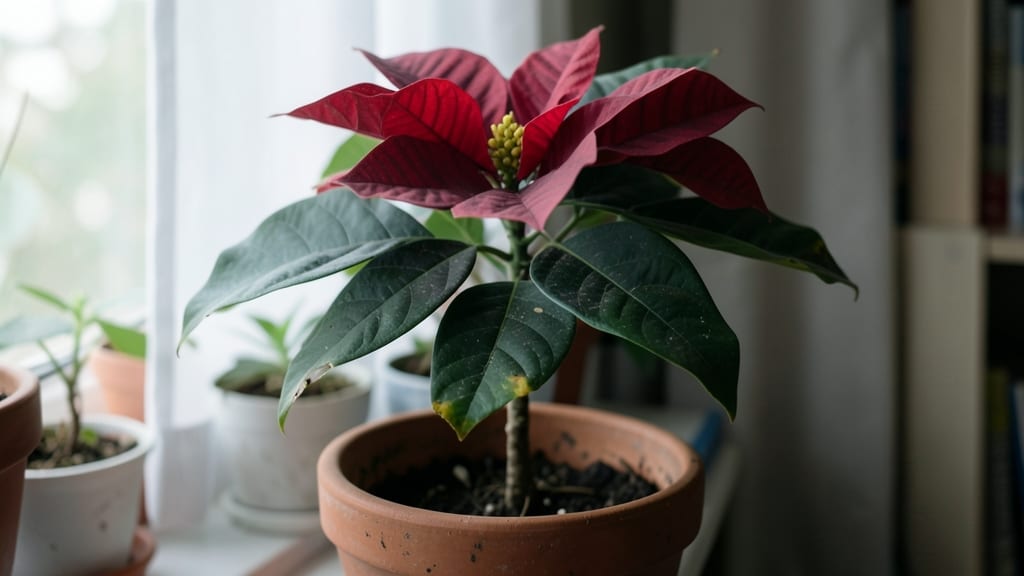
Poinsettias bloom between late November and December, aligning with the winter holidays, though timing depends on light exposure and variety. Indoor plants often flower earlier with artificial light manipulation, while outdoor varieties follow natural seasonal cues.
Poinsettias are short-day plants, meaning they need 12+ hours of darkness daily to initiate flowering—a process called photoperiodism. 🌙 If you want them to bloom earlier, like for Thanksgiving, you can use blackout covers or grow lights to control their light exposure.
Outdoor plants, however, naturally sync with seasonal daylight changes, so they typically bloom later than their indoor counterparts.
Once they flower, these vibrant plants thrive with bright, indirect light and moderate watering. 💫 To encourage reblooming, keep them in consistent conditions and avoid letting them dry out completely. This way, you can enjoy their festive colors year after year!
💡 In This Article
- How Light Exposure Controls Poinsettia Blooming Cycles
- Best Practices for Timing Poinsettia Flowers Year-Round
How light exposure controls poinsettia blooming cycles
Poinsettias are short-day plants, meaning their blooming is triggered by 12+ hours of uninterrupted darkness each day—a phenomenon called photoperiodism. This mechanism works because their natural habitat in Mexico's highlands receives shorter daylight hours during winter months.
When exposed to 14 hours of light or less daily, the plant's phytochrome pigments detect the shift and begin producing florigen, a hormone that initiates flower bud formation. 🌙
The key here is consistency. Even a brief interruption—like a streetlight shining overnight—can delay blooming by weeks. For example, a 15-minute light exposure during the dark period might reset the cycle entirely.
Outdoor poinsettias naturally experience this darkness as daylight shortens in late summer, while indoor plants need artificial control to mimic these conditions. Growers often use blackout covers or timed grow lights to create the perfect 8-10 hour daylight window needed for blooming.
Indoor plants can bloom 4-6 weeks earlier than outdoor varieties when given controlled light schedules. For instance, starting the 12-hour dark period at 6 PM and keeping lights off until 6 AM creates the ideal trigger.
Outdoor plants, however, rely on natural daylight, so their blooming aligns with the winter solstice when daylight drops below 10 hours daily. This explains why store-bought poinsettias often appear in late November, while garden-grown ones may not peak until December. 💫
Temperature also plays a supporting role. Poinsettias thrive in 65-75°F conditions, but cooler nights (55-60°F) can enhance flower development. The combination of darkness and moderate temperatures signals the plant to shift from vegetative growth to reproductive mode.
Without this dual trigger, buds may form poorly or not at all. This is why tropical varieties sometimes struggle in warm indoor environments—they need both the light schedule and the temperature cues to bloom reliably.
Here's what happens when you get it wrong: Too much light (16+ hours) keeps poinsettias in a vegetative state, while inconsistent darkness can cause buds to drop prematurely. For example, a plant receiving 10 hours of light one day and 14 hours the next may never fully bloom.
This sensitivity is why professional growers use automated light systems to maintain precision. At home, a simple blackout box or even covering the plant with a dark blanket for 12 hours nightly can work wonders. ✨
The science behind this involves phytochrome Pfr, a light-sensitive protein that converts to its active form during daylight. When darkness falls, Pfr gradually reverts to its inactive form, signaling the plant to begin flowering.
This conversion takes about 8 hours of complete darkness to complete, which is why even small light leaks can disrupt the process. Understanding this helps explain why poinsettias bloom so reliably during winter—they're not just following a calendar, they're responding to a biological clock calibrated by light. 💡