
Blooming
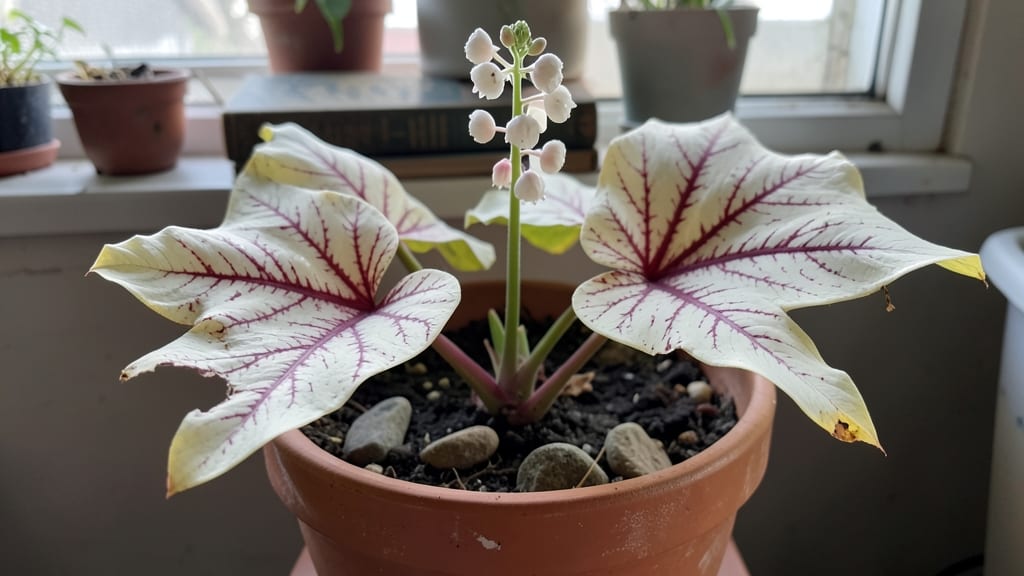
Caladiums rarely bloom indoors because they prioritize foliage growth over flowers in low-light conditions. Outdoor plants may produce small, insignificant white or greenish blooms under ideal sunlight and warmth, but their striking leaves are their primary appeal. Encouraging flowers requires specific care adjustments.
Caladiums are all about that foliage—those vibrant leaves are their signature move in the plant world. 🌿 In their natural tropical habitats, they focus energy on leaf production because it helps them compete for sunlight in dense forests.
When you bring them indoors, the lack of bright light tricks them into thinking they’re still in that shady environment, so they skip the flower show entirely. It’s like they’re saying, "Why waste energy on blooms when I can grow bigger, better leaves?"
Outdoor caladiums get a different deal with plenty of sunlight and warmth, which signals them to shift gears and produce those small, often overlooked white or greenish blooms. But here’s the catch: even outdoors, the flowers are usually an afterthought compared to the dramatic foliage.
If you’re dreaming of a flower explosion, you’ll need to tweak their care—think brighter light, consistent moisture, and maybe even a little extra fertilizer to nudge them in the right direction.
💡 In This Article
- Why Caladiums Skip Flowers Indoors
- How to Boost Caladium Flowering Outdoors
Why caladiums skip flowers indoors
Caladiums are hardwired to prioritize leaf production over flowers because they evolved in the dense, low-light understories of tropical forests. In these environments, sunlight is scarce, so the plant's survival strategy is to maximize foliage for photosynthesis rather than expend energy on reproductive structures like blooms.
When you bring them indoors, they receive even less light than their natural habitat—typically 10-30% of full sunlight—which triggers their vegetative growth mode. This is why most indoor caladiums focus entirely on producing those stunning, heart-shaped leaves while completely skipping the flowering stage. 🌿
The botanical mechanism behind this behavior involves photoperiodism—the plant's response to light duration and intensity. Caladiums require bright, indirect light for at least 6 hours daily to stimulate flowering hormones like florigen. Without sufficient light, the plant defaults to vegetative growth, diverting energy to leaf expansion instead.
Even in outdoor settings, caladiums often produce only 1-3 small blooms per plant because their primary evolutionary advantage lies in their foliage, not their flowers.
The contrast between indoor and outdoor flowering is striking: outdoor plants may develop white or pale greenish flowers that resemble tiny calla lilies, while indoor plants might never bloom at all.
Temperature fluctuations indoors also play a role in suppressing blooms. Caladiums thrive in 70-80°F conditions and struggle with drafts or sudden temperature drops below 60°F. Indoor environments often have inconsistent heating or cooling, which stresses the plant and redirects its energy toward survival rather than reproduction.
Even outdoor plants may skip flowering if they experience temperature swings or insufficient warmth during their growing season.
The key difference is that outdoor caladiums receive both the bright light and consistent warmth needed to trigger flowering mechanisms, while indoor plants typically lack one or both of these critical factors. 🌡️
Another factor is the plant's energy allocation system. Caladiums store energy in their rhizomes (underground stems), which they use to fuel either leaf growth or flower production. In low-light conditions, the plant conserves energy by prioritizing foliage, which captures more sunlight for photosynthesis.
This is why even well-cared-for indoor caladiums may produce larger leaves but no flowers. The trade-off is clear: vibrant foliage means no blooms, while outdoor conditions that support both light and warmth may finally coax those small, often overlooked flowers into existence.
Understanding this energy dynamic helps explain why caladiums are primarily grown for their leaves rather than their flowers.
What most people don't realize is that caladium flowers serve a secondary purpose in nature—they're primarily designed to attract pollinators in their native tropical environments. The blooms are often short-lived (2-4 days) and lack the showy appeal of their foliage, which is why gardeners rarely prioritize them.
Even when outdoor caladiums do flower, the blooms are typically insignificant in size and color, making them a secondary concern for most growers. This evolutionary focus on foliage over flowers is what makes caladiums such a popular choice for indoor decoration—their leaves are their true star attraction. 🌟
For those determined to see caladiums bloom, the solution lies in replicating their outdoor growing conditions as closely as possible. This means providing bright, indirect light, maintaining consistent temperatures between 70-80°F, and ensuring the plant receives adequate nutrients through regular fertilization.
Even then, the flowers may still be modest in appearance, but the effort can be rewarding for those fascinated by the plant's complete lifecycle. The key takeaway is that caladiums are foliage plants first and flowers second—a fact that aligns perfectly with their tropical origins and survival strategies. ✨