
Blooming
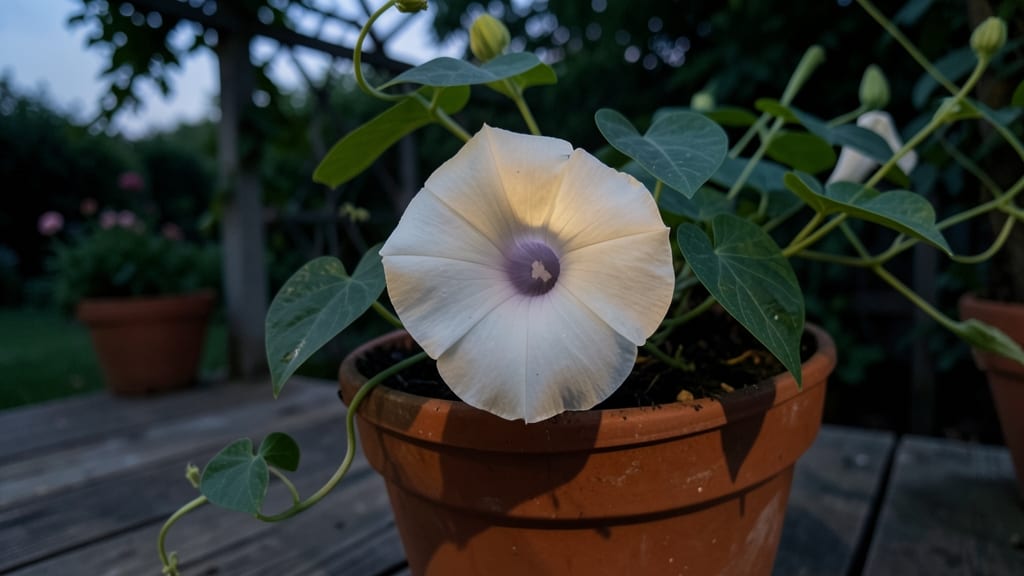
Moon flowers bloom at night because their petals respond to darkness through circadian rhythms, triggered by ethylene gas production when sunlight fades. These nighttime blooms specifically attract nocturnal pollinators like moths, ensuring reproductive success in low-light conditions.
This unique behavior isn't just about timing—it's a survival strategy. 🌙 The flowers' petals stay tightly closed during daylight hours, conserving moisture, then expand rapidly when night falls. This adaptation evolved to take advantage of moths' active foraging periods, which peak after sunset.
Many gardeners report their moon flowers open most dramatically under a full moon, though they'll still bloom on cloudy nights when light levels drop sufficiently.
What's fascinating is how these flowers "know" when to bloom. Their internal clocks, regulated by genes similar to those in humans, track light exposure patterns. When darkness signals evening, ethylene gas builds up in the petals, causing them to unfurl.
This biological mechanism makes moon flowers particularly sensitive to artificial lighting—keeping them near streetlights or porch lamps can disrupt their natural cycle and prevent nighttime openings.
💡 In This Article
- How Moon Flowers Detect Darkness to Trigger Blooming
- Growing Tips to Ensure Moon Flowers Open at Night
How moon flowers detect darkness to trigger blooming
The secret behind moon flowers' nighttime display lies in their specialized photoperiodism—a biological response to light duration. These flowers contain phytochrome pigments in their petals that act like natural light sensors, detecting even subtle changes in ambient light levels.
When sunlight fades below 1,000 lux (about the brightness of a full moon), these pigments trigger a cascade of chemical reactions. 🌙
At the cellular level, darkness activates ethylene gas production in the petal tissues, causing cells to elongate rapidly through a process called cell turgor pressure increase.
This mechanism is similar to how morning glories close their petals during daylight, but moon flowers take it further by synchronizing their blooming with nocturnal pollinators like hawk moths and sphinx moths.
Studies show these flowers can open their 5-inch-wide petals in just 30-60 minutes after sunset, a speed unmatched by most diurnal bloomers.
What makes this even more remarkable is their circadian clock genes, specifically CCA1 and LHY, which regulate the entire process. These genes maintain a 24-hour internal rhythm that predicts darkness, even in controlled environments without natural light fluctuations.
Unlike roses or sunflowers that rely on sunlight for energy, moon flowers have evolved to conserve water during the day by keeping petals tightly closed, then "waste" precious moisture at night when humidity is higher and temperatures drop.
Artificial lighting can disrupt this delicate balance. Indoor grow lights emitting blue spectrum wavelengths (400-500nm)—similar to daylight—trick moon flowers into staying closed. Gardeners often notice their plants bloom more reliably when placed in south-facing locations with 6+ hours of direct sunlight, followed by complete darkness after dusk.
The contrast between bright daytime and pitch-black nights reinforces their natural blooming cues.
Interestingly, moon flowers exhibit temperature sensitivity too. Nighttime blooming is most reliable when evening temperatures stay above 60°F (15°C). Cooler nights can delay opening, while sudden temperature drops below 50°F (10°C) may cause petals to wilt before fully unfurling.
This explains why they thrive in Mediterranean climates where warm days transition smoothly into mild nights—perfect conditions for their nocturnal strategy. 🌟
Comparing moon flowers to their daytime counterparts reveals an evolutionary arms race. While sunflowers maximize photosynthesis during peak sunlight, moon flowers prioritize pollinator access when competition for night-flying insects is minimal. Their petals often contain reflective patterns** that guide moths using ultraviolet light, a feature absent in most daytime bloomers.
This dual adaptation—chemical signaling and visual cues—makes their nighttime display both a biological marvel and a gardener's delight.