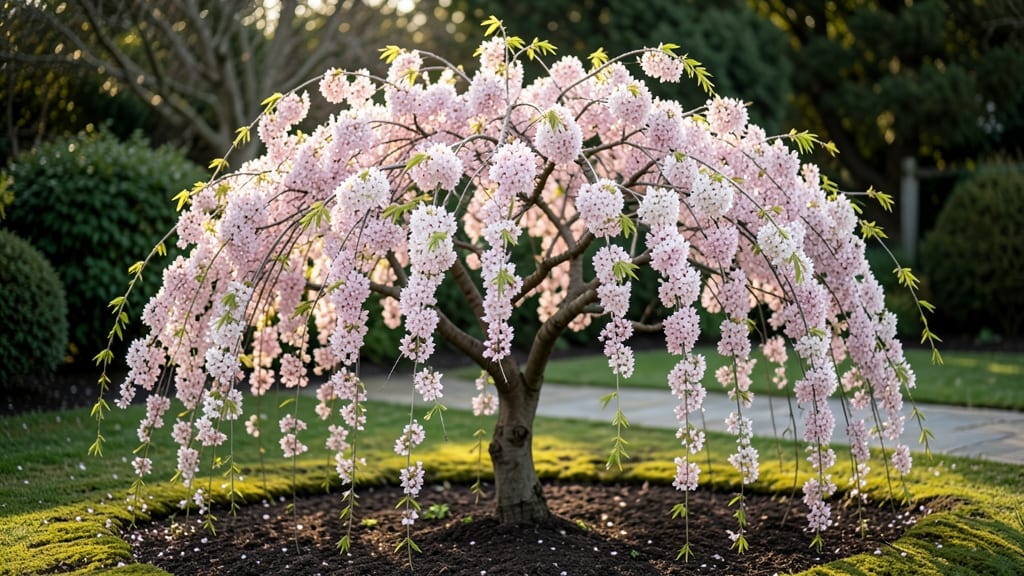
| Prunus subhirtella ‘Pendula’ |
Late winter (Feb–early Mar) |
Pink-white |
Early bloomer, reblooms lightly |
Bud swell in Jan, leaves emerge after blooms |
| Prunus serrulata ‘Kwanzan’ |
Mid-April |
Deep pink |
Classic spring bloomer, no rebloom |
Bud swell in Mar, leaves emerge with blooms |
| Prunus serrulata ‘Shirofugen’ |
Early April |
Pure white |
Reblooms lightly in summer |
Bud swell in Feb, leaves emerge before blooms |
| Prunus serrulata ‘Amanogawa’ |
Late March |
Light pink |
Dwarf variety, early bloomer |
Bud swell in Jan, compact growth |
| Prunus serrulata ‘Cameo’ |
Early April |
Dark pink |
Resistant to black knot |
Bud swell in Mar, leaves emerge with blooms |
| Prunus serrulata ‘Mount Fuji’ |
Mid-April |
White |
Upright-weeping habit |
Bud swell in Mar, leaves emerge after blooms |
| Prunus serrulata ‘Taihaku’ |
Early April |
White with pink blush |
Heavy bloomer, fragrant |
Bud swell in Feb, leaves emerge with blooms |
| Prunus subhirtella ‘Autumnalis’ |
Feb–Mar (reblooms) |
Pink-white |
Blooms on old wood, cold-hardy |
Bud swell in Dec, leaves emerge after blooms |
How climate zones shift weeping cherry bloom time (USDA map guide)
Your weeping cherry tree’s bloom time isn’t set in stone—it shifts dramatically based on your USDA hardiness zone. In Zone 8, you might see delicate pink blossoms as early as late February, while gardeners in Zone 5 often wait until mid-April for the same spectacle.
These differences matter for planning spring garden events or simply enjoying your tree’s show.
Understanding these shifts helps you prepare for frost risks and choose the right weeping cherry variety for your climate. For example, Prunus subhirtella varieties like ‘Autumnalis’ bloom earlier in warmer zones, while Prunus serrulata types may lag behind in colder areas.
Let’s break down how your zone affects bloom timing and what you can do to protect your tree’s flowers.
⚠️ Late Bloomers in Transition Zones
Zones 6-7 are tricky because they straddle early and late bloomers. If your tree blooms in early April, a late frost (common in these zones) can devastate flowers. Monitor forecasts and consider frost cloth for young trees. Varieties like ‘Shirofugen’ (white blooms) are slightly more frost-tolerant than ‘Kwanzan’ (deep pink), but no weeping cherry is truly frost-proof.
In Zone 5, weeping cherries typically bloom 2-3 weeks later than in Zone 8 due to colder winters. For instance, while Zone 8 gardeners might see buds swell in early March, Zone 5 trees often wait until mid-March or later.
This delay is critical for planning pruning—wait until after blooms fade to avoid cutting off next year’s flowers.
For Zone 9 gardeners, the opposite challenge arises: heat stress can shorten bloom seasons. Trees here may bloom as early as January, but hot spells can cause buds to drop before opening. Choose heat-tolerant varieties like ‘Pendula’ or provide afternoon shade during extreme heat waves to preserve blooms.
Here’s a quick zone-by-zone bloom calendar to reference:
- Zone 5: Late March–Mid-April
- Zone 6: Mid-March–Early April
- Zone 7: Early March–Mid-April
- Zone 8: Late February–Early March
- Zone 9: January–February
Use these dates as guidelines—your tree’s exact timing depends on microclimates (e.g., urban heat islands) and tree maturity.
Pro tip: If you’re in a transition zone (like Zone 6b), plant your weeping cherry near a south-facing wall to create a warmer microclimate. This can push bloom times 1-2 weeks earlier and reduce frost risk. Just avoid planting in frost pockets where cold air settles.
Finally, remember that young trees (under 5 years) may bloom 1-2 weeks later than mature specimens. Patience is key—give your tree time to establish strong roots before expecting a full bloom display. With the right zone knowledge, you’ll be ready to celebrate your weeping cherry’s pink waterfall every spring! 🌸
★★★★★4.7(10 reviews)