
Blooming
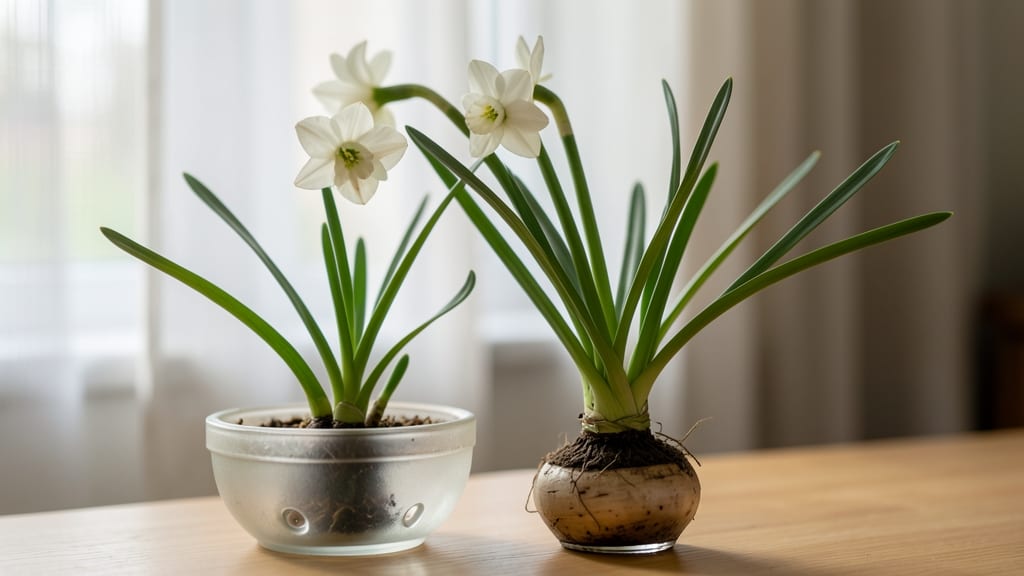
Paperwhites will not bloom again after their first flowering because they are annuals that deplete their energy reserves during bloom. Once they finish flowering, their life cycle ends, but their foliage remains for several weeks before dying back naturally.
Paperwhites are one-season wonders because their bulbs exhaust all stored energy producing flowers, leaving nothing left for reblooming. 🌱 Unlike perennials like tulips, they don't have the reserves to regenerate. Think of them as nature's fireworks—they put on one spectacular show before fading away.
However, their green leaves can stay vibrant for weeks after blooms wilt, continuing to photosynthesize until they naturally yellow and wither.
What's interesting is how their bulb structure differs from other bulbs. Paperwhites have a single, compact bulb that doesn't form new growth points after flowering, while perennials develop multiple layers.
This structural difference explains why you won't see paperwhites rebloom—they simply don't have the biological capacity to store enough energy for another cycle.
💡 In This Article
- Why Paperwhites Are Annuals and Their Life Cycle
- What to Do With Paperwhites After Flowering
Why paperwhites are annuals and their life cycle
Paperwhites are classified as annuals because their entire life cycle—from rooting to flowering—relies on a single bulb's stored energy, which gets completely depleted during bloom. Unlike perennial bulbs like daffodils or tulips, paperwhites lack the layered structure to regenerate.
Their compact bulb contains only one growth center that exhausts its 10-12% starch reserves (measured in bulb weight) during the 4-6 week flowering period. This energy depletion is irreversible, making reblooming biologically impossible.
The life cycle begins when the bulb roots in moist conditions, typically taking 2-3 weeks to establish before shooting up. During this phase, the bulb converts stored starches into sugars through photosynthesis in the emerging leaves.
Once flowering starts, the plant diverts nearly all energy to producing 6-12 fragrant white flowers, each lasting 5-7 days. The scent, containing benzaldehyde (the same compound in almonds), signals the bulb's final energy expenditure.
After blooming, the foliage continues photosynthesizing for 4-6 more weeks, but this is purely for nutrient recycling. The bulb's vascular system begins senescing—its cells break down systematically, returning nutrients to the bulb.
You'll notice the leaves yellowing from the base upward, a clear sign of programmed cell death. This process ensures no energy remains for future growth cycles, unlike perennials that maintain dormant buds.
Structurally, paperwhites differ from perennials in their bulb composition. Perennial bulbs like tulips have multiple layers (tunics) that store energy incrementally, while paperwhites have a single, papery tunic that doesn't regenerate. Their 1-2 inch diameter bulbs are also smaller than perennials, further limiting their energy capacity.
This biological limitation explains why even with optimal care, paperwhites won't rebloom—they're designed for a one-time floral display.
What's fascinating is how this annual cycle mirrors their wild counterparts. In nature, paperwhites (Narcissus papyraceus) grow in Mediterranean regions where they bloom once in winter, then die back as temperatures rise.
This adaptation ensures they complete their life cycle before summer droughts. Cultivated varieties follow the same pattern, making them nature's perfect seasonal performers.
For gardeners, this means treating paperwhites as temporary beautifiers rather than long-term investments. Their entire purpose is to provide that Christmas-to-New Year burst of fragrance and color, knowing full well they'll fade away. The trade-off? Their ephemeral nature makes each bloom feel extra special, like a fleeting gift from nature.