
Blooming
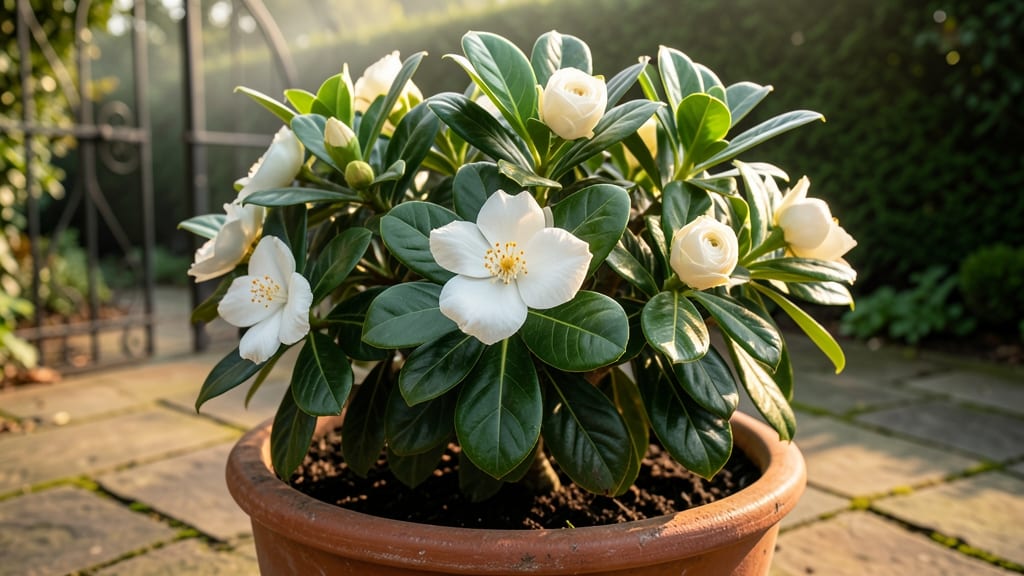
Gardenias don't bloom all summer, as most varieties flower mainly in spring and early summer, with occasional late-season blooms in mild climates. Extreme heat, drought, or high humidity can drastically reduce their flowering time.
Gardenias are seasonal bloomers, with their flowering cycles closely tied to temperature shifts and daylight hours. 🌸 Most varieties—like the popular G. jasminoides—enter dormancy during peak summer heat, conserving energy until cooler autumn temperatures return.
Coastal regions often see extended blooming periods because of their moderated temperatures, while inland areas may experience more pronounced seasonal breaks. The key to encouraging blooms lies in mimicking their natural environment: consistent moisture, partial shade during hot afternoons, and balanced fertilization rich in phosphorus to support flower production.
Understanding your specific gardenia variety helps too. Some tropical hybrids, like G. radicans, may produce sporadic blooms throughout the year in ideal conditions, but even these respond best to seasonal cues.
If you're noticing early wilting or bud drop, it's often a sign of stress from improper watering or sudden temperature swings—both common culprits in shortened bloom seasons.
💡 In This Article
- Gardenia Bloom Seasons by Variety and Climate
- Extending Gardenia Blooms: Pruning, Fertilizing, and Heat Management
Gardenia bloom seasons by variety and climate
The blooming patterns of gardenias are deeply influenced by their native tropical origins, where they experience distinct wet and dry seasons. Most varieties, particularly the widely cultivated G. jasminoides, follow a natural rhythm of producing flowers in response to cooler temperatures and increased daylight during spring and early summer.
This aligns with their evolutionary adaptation to avoid the harshest heat of mid-summer, which can exceed 90°F in many regions. 🌿 In fact, research shows that gardenias often enter a semi-dormant state when daytime temperatures consistently surpass 85°F, conserving energy for future blooms.
Climate plays a crucial role in determining bloom duration. Coastal gardenias, for instance, benefit from the moderating influence of ocean breezes, which prevent extreme temperature fluctuations.
In these environments, you might see sporadic blooms extending into late summer or even early fall, especially in varieties like G. radicans, which is more tolerant of humidity.
In contrast, inland areas with hotter, drier summers often experience a more pronounced bloom break, with flowers appearing primarily from April to June before the plant focuses on foliage growth. The difference is striking: coastal gardenias may produce 30-50% more flowers over a longer season compared to their inland counterparts.
Daylight hours also trigger blooming cycles. Gardenias are short-day plants, meaning they respond to decreasing daylight as summer progresses. When days start shortening in late summer, the plant receives a signal to prepare for dormancy, often resulting in fewer blooms.
This is why gardenias in northern climates (USDA Zones 7-9) typically have a 6-8 week bloom window, while those in subtropical zones (Zones 10-11) may experience more continuous but less abundant flowering. The key takeaway?
Gardenias are seasonal performers, and their bloom cycles are hardwired to align with natural environmental cues.
Humidity levels further complicate bloom timing. While gardenias thrive in 50-70% humidity, excessive moisture during hot periods can stress the plant, leading to bud drop and reduced flowering.
In humid climates like Florida or Hawaii, gardenias may produce flowers year-round but often in smaller quantities due to the lack of distinct seasonal contrasts.
The contrast is evident when comparing a gardenia in a greenhouse with controlled humidity (60%) versus one outdoors during a 95% humidity summer—the latter may see blooms drop by 40%.
Variety-specific traits also matter. G. augusta, for example, is known for its larger, more fragrant blooms but follows a stricter seasonal pattern, while G. fortuniana hybrids may produce smaller flowers more sporadically. Understanding these differences helps gardeners set realistic expectations.
For instance, if you're growing G. jasminoides 'Kleim's Hardy', expect a concentrated bloom period in spring, whereas G. radicans might reward you with occasional blooms even in summer, provided you manage heat stress.
One fascinating exception is the G. tabucacha, a rare variety that can bloom year-round in ideal conditions, thanks to its tolerance for higher temperatures (up to 95°F). However, this variety remains a specialty and isn't widely available.
For most gardeners, the reality is that gardenias are seasonal bloomers, and their performance is a delicate balance of climate, variety, and care. 🌸