
Blooming
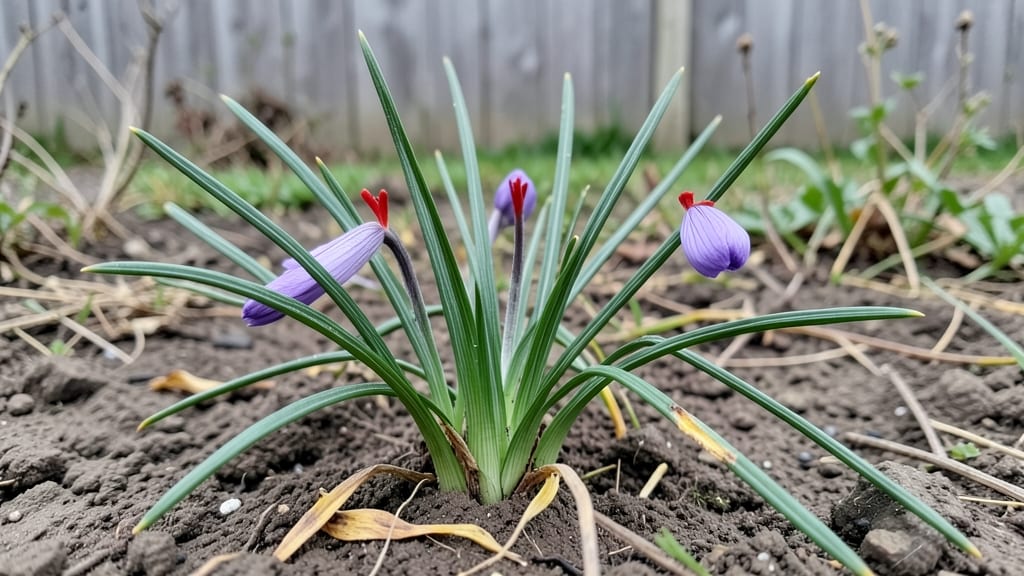
Saffron crocus blooms in late summer to early fall, typically between September and November, depending on climate and altitude, with cooler regions seeing earlier flowering.
These delicate flowers thrive when temperatures drop, often opening their vibrant blooms in response to cooler mornings and crisp evenings. 🌸 In Mediterranean climates, they might appear as early as August, while higher elevations or northern latitudes can push blooming into December.
The key trigger is a combination of shorter daylight hours and dropping temperatures, which signals the plant to flower and produce saffron.
What's fascinating is how altitude plays a role—plants grown above 5,000 feet often bloom earlier than those at lower elevations. This variation is why saffron harvests can span from late summer to winter, depending on where you are.
For gardeners, understanding these patterns helps time planting and care for the best possible yield.
💡 In This Article
- Climate and Altitude Factors Affecting Saffron Crocus Bloom Timing
- Planting and Care Tips to Control Saffron Crocus Flowering
Climate and altitude factors affecting saffron crocus bloom timing
Here's what's actually happening with saffron crocus blooms: these plants are triggered by a combination of photoperiodism (daylight sensitivity) and thermoperiodism (temperature cycles). The crocus needs 10-12 weeks of cool temperatures below 60°F to break dormancy, which explains why cooler climates see earlier blooms.
In regions like Iran's Khorasan province, where winters are harsh, flowers often appear by late September, while Mediterranean coastal areas might wait until November.
The altitude effect works through temperature gradients—every 1,000 feet increase typically drops temperatures by 3.5°F. At 3,000 feet elevation, blooms may appear 2-3 weeks earlier than at sea level because the cooler nights accelerate the flowering signal.
This is why Spanish saffron from La Mancha (average elevation 2,300 feet) harvests earlier than French saffron from Provence (1,000 feet). The shorter growing season at higher elevations forces the plant to prioritize reproduction over foliage growth.
Daylight hours create another critical trigger. Saffron crocus responds to 12-14 hours of daylight during summer, but when days shorten to 10-12 hours in fall, it initiates flowering. This photoperiod sensitivity explains why equatorial regions (like parts of South America) can produce blooms year-round, while temperate zones have distinct seasons.
The plant's internal clock measures these changes through a process called vernalization, where cold exposure verifies the timing is right for flowering.
What most people don't realize is that soil temperature matters just as much as air temperature. The crocus roots need to experience 50-55°F soil temps for proper development. In warmer climates, gardeners often use shade cloth during summer to keep soil temperatures down, effectively mimicking higher altitude conditions.
This technique can advance blooming by 3-4 weeks in heat-prone areas like California's Central Valley.
Regional variations create fascinating extremes. In Kashmir (India), where elevations exceed 5,000 feet, saffron blooms as early as mid-August due to the high-altitude climate. Meanwhile, in Greece's Peloponnese region, blooms may not appear until December because of the milder winters.
These differences explain why saffron harvests can span from late summer to winter, with each region producing its own seasonal variation.
The science behind this involves a hormone called florigen, which the plant produces in response to these environmental cues. When daylight shortens and temperatures drop, florigen accumulates in the leaves and travels to the growing tips, triggering flower formation.
This hormonal response is why you'll sometimes see saffron crocus blooms after just 6-8 weeks of proper chilling, even when planted in late summer.
For gardeners, understanding these factors means you can predict bloom times within 2 weeks by tracking your local climate data. The key is monitoring both minimum nighttime temperatures and daylength changes—when both drop below their thresholds, you're looking at blooms within 4-6 weeks. 💫